Data recovery for BeeStation BST150 after a drop in Brussels
The problem
Every photo a Brussels family had lived in one place: a 4 TB Synology BeeStation BST150 standing upright on a shelf. There was no second copy anywhere, because the station was itself the backup for the phones and the home computer. During building work someone knocked the shelf and the narrow, vertical unit fell on its side. After that the BeeStation would not start: no network access, nothing normal at power-up. The owner brought it to us without having tried to switch it on again and again, and that counted for a lot later.
Our intervention
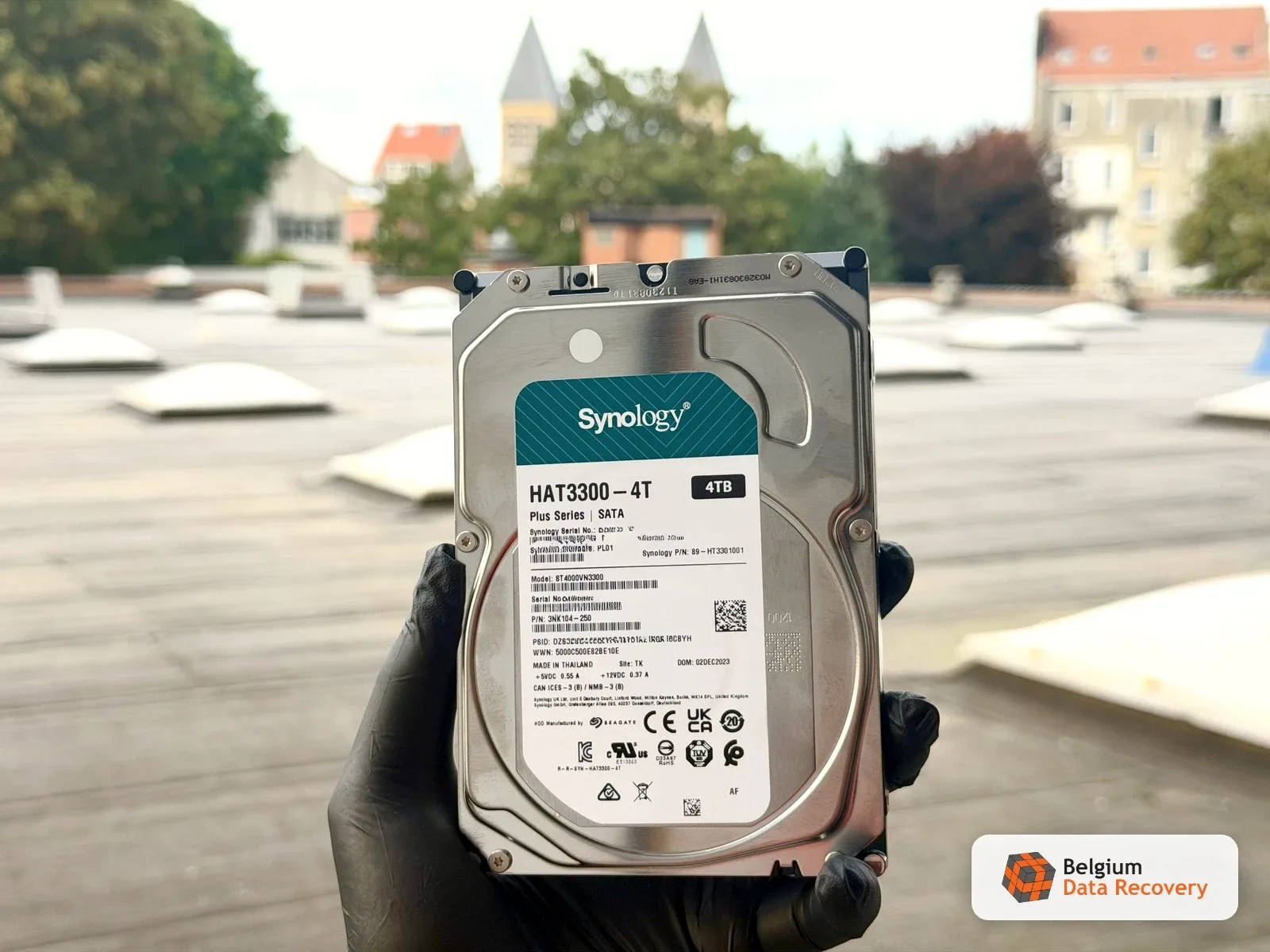
Under the Synology label sat a 4 TB Seagate drive with media cache, taken out of the enclosure in the lab. The fall had damaged the heads: the drive could no longer read its service area and never reached ready state. Firmware access was locked too, and that is where most of the difficulty was. We unlocked the ROM on the board, rewrote it and adjusted the drive's passport settings so it would start in technological mode without touching the damaged areas. A head map was then built: the failed heads excluded from reading, the good ones doing the work. The point was not to wear them out for nothing. Instead of a full 4 TB image, we located the partition, analysed its structure and read only the areas holding the photos, 300 GB in all. The reading itself ran over a week, at reduced speed and in several passes, to spare heads that were already weakened.
Result
The fall hit the heads, not the surface where the data lived, and that is what makes the result complete. All 300 GB of family photos were returned at 100%, with no missing files, on a new drive handed to the client.
Frequently asked question
BeeStation BST150 after a drop: can the data be recovered?
Under the Synology label sat a 4 TB Seagate drive with media cache, taken out of the enclosure in the lab. The fall had damaged the heads: the drive could no longer read its service area and never reached ready state. Firmware access was locked too, and that is where most of the difficulty was. We unlocked the ROM on the board, rewrote it and adjusted the drive's passport settings so it would start in technological mode without touching the damaged areas. A head map was then built: the failed heads excluded from reading, the good ones doing the work. The point was not to wear them out for nothing. Instead of a full 4 TB image, we located the partition, analysed its structure and read only the areas holding the photos, 300 GB in all. The reading itself ran over a week, at reduced speed and in several passes, to spare heads that were already weakened. The fall hit the heads, not the surface where the data lived, and that is what makes the result complete. All 300 GB of family photos were returned at 100%, with no missing files, on a new drive handed to the client.
Related service: NAS data recovery